

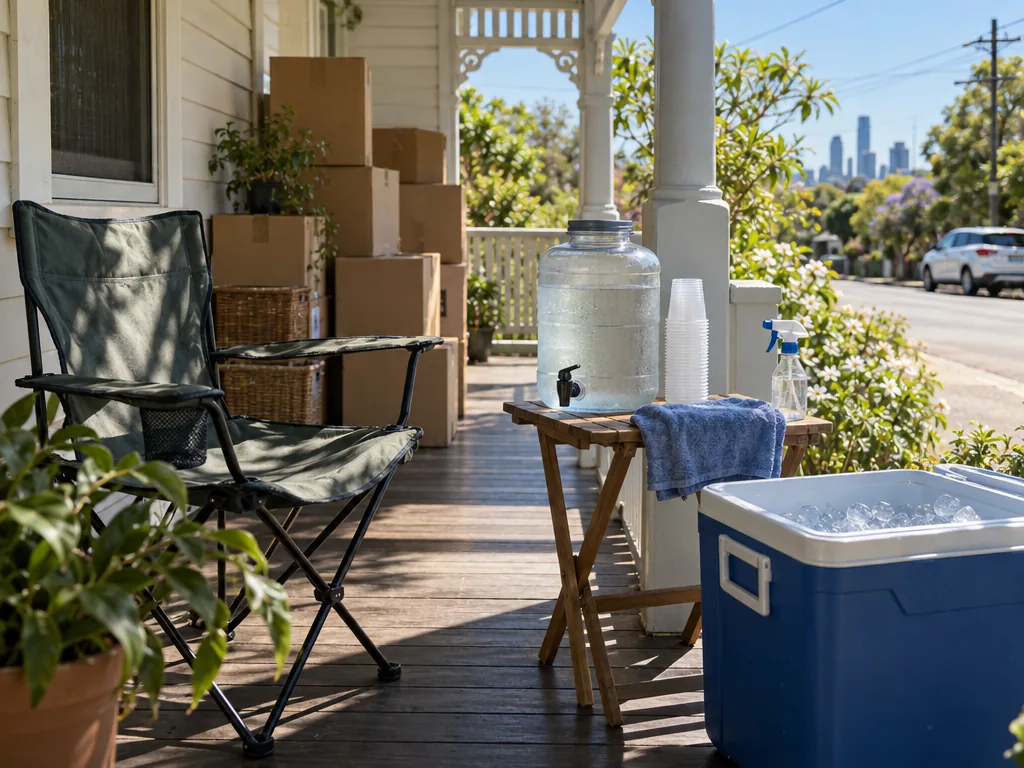
If your move lands in a run of hot weather, plan for a slower day and far more water than you would guess.
SafeWork NSW's benchmark for physical work in heat is to drink a small cup (200 ml) of cool, not cold, water every 15 to 20 minutes. That works out to 600 to 800 ml an hour for each person carrying (our estimate). Northern Beaches Council's hot-weather advice is 2 to 3 litres of water a day. At SafeWork's pace, a friend helping you lift gets through that whole daily amount in roughly 2.5 to 5 hours (our estimate: 2 litres at 800 ml an hour, 3 litres at 600 ml an hour).
The clock stretches too. For hot, humid, physical work, SafeWork says to rest about every hour in a cooler or shaded place, up to 30 minutes in every hour as conditions worsen. If half of every hour goes to rest, the same carrying takes about twice as long on the clock (our estimate).
So stock water for the job, not for the day. Do the heavy work while it is cool, and expect the afternoon to move slower than the morning. At Palm Beach Removals, that is where we would start anyone planning a summer move. The rest of this guide covers the people, pets and belongings that need looking after when the heat arrives.
What counts as a heatwave, and how much warning you get
A heatwave is 3 days or longer when both minimum and maximum temperatures are unusually hot.
| Grade | What it means |
|---|---|
| Low-intensity | Frequent in summer, most people can cope |
| Severe | Harder for vulnerable people such as older Australians |
| Extreme | A problem for anyone who doesn't keep cool |
Source: Bureau of Meteorology, heatwaves: what you need to know
A heatwave is not one hot day: the Bureau of Meteorology defines it as 3 days or longer when both the maximum and minimum temperatures are unusually hot, so a cool night breaks it.
One or two unusually hot days still matter on a moving day. The Australian CDC calls that extreme heat, and treats 3 or more days as a heatwave.
The Bureau grades heatwaves in three steps. Low-intensity heatwaves are frequent in summer and most people can cope. Severe ones are harder for vulnerable people such as older Australians, and extreme ones are a problem for anyone who doesn't keep cool.
"Unusually hot" is not a fixed number. The Bureau sets the threshold by location and the previous 30 days, and it takes higher temperatures to qualify late in summer than early on. An early-summer hot spell after a cool fortnight can therefore count as a heatwave at a temperature a February one would not.
This is worth taking seriously. The Bureau calls heatwaves Australia's most deadly natural hazard.
When to check the forecast for a summer move
- 7 days out BoM heatwave forecasts reach up to 7 days ahead.
- 4 days out Warnings for severe or extreme heatwaves up to 4 days ahead. Warnings issued at 3 pm local time, on the BOM Weather app and the Warnings page.
- Moving day.
Warnings give expected maximum and minimum temperatures, timing and affected towns.
Check twice: once when you book, and again in the week before.
The Bureau forecasts heatwaves up to 7 days ahead and warns for severe or extreme heatwaves up to 4 days ahead. Warnings are issued at 3 pm local time on the BOM Weather app and the Warnings page. Each one gives the expected maximum and minimum temperatures, the timing and the affected towns.
The season is long. The Bureau says its heatwave forecasts and warnings are generally issued from October until the end of March, and the service can start earlier or run later. The NSW Government puts Bureau warnings from November to the end of March, and adds that NSW Health can issue a heat alert at any time if early-season heat is forecast.
That season covers the busiest moving stretch of the year. Eastern division summer school holidays run Fri 18 December 2026 to Wed 27 January 2027. If you are aiming for that window, our guide to moving house over Christmas on the Northern Beaches covers the dates and closures. Summer storms are the other weather risk, and our storm-season moving plan covers those.
Fire danger is a separate check from a heatwave warning. Council notes that hot days can bring bushfire risk, and its January 2026 notice said the Sydney Fire Danger Rating was set to reach Extreme. It points residents to the Northern Beaches Emergency Dashboard, Fires Near Me and NSW Ambulance heatwave warnings.
If a severe or extreme heatwave warning appears 2 to 4 days before your move, talk to whoever is moving you that day. An earlier start, a buffer day or a different date may each be options. Ask any removalist you are considering, us included, how a very hot move day is handled before you book, so the answer is not a surprise later.
How to run a hot moving day
Start early. SafeWork's advice is to schedule heavy work for the cooler parts of the day, so the biggest pieces go first, while the shade still reaches the driveway.
Water goes out on a schedule, not on request. SafeWork's guidance is don't wait until you're thirsty. Set up a jug of cool water and cups somewhere everyone passes.
Pair people up. SafeWork recommends a buddy system so helpers check each other. The same page records that 13 Australian workers died from extreme heat at work between 2001 and 2013, with failure to recognise the signs a recurring theme.
The thermometer is not the whole story. SafeWork says heat risk also depends on humidity, air movement, radiant heat and clothing. A still, humid morning on a sun-facing stair can be harder going than the forecast suggests.
Skip the salt tablets: SafeWork says don't take salt tablets, because the body needs more water to shed the salt and they raise the risk of dehydration.
Leave energy drinks, coffee and alcohol for another day. The CDC adds sugary, caffeinated or alcoholic drinks to the list to avoid.
Who is most at risk, and the signs to watch for
| Stage | Signs | What to do |
|---|---|---|
| Early signs | Thirst, heavy sweating, dizziness or feeling faint, tiredness, irritability, dark urine, cramps | Cool down straight away |
| Heat exhaustion | Body temperature 38 to 39 °C, pale skin, persistent cramps, nausea, fainting | Take immediate steps to cool down |
| Heatstroke, a medical emergency | Hot dry skin with no sweating, body temperature above 40 °C, confusion, slurred speech, collapse | Call 000 and ask for an ambulance, and cool the person while waiting |
The CDC lists the people at higher risk in heat: people who exercise or work outdoors, older people living alone, babies and young children, pregnant or breastfeeding people, people with chronic conditions, and people on certain medications such as diuretics, beta-blockers, antidepressants and antipsychotics. SafeWork adds people over 45 and people not used to working in heat.
On moving day that list often covers the helpers themselves. It can include the uncle who offered to carry, the grandparent minding the kids, or a pregnant friend packing the kitchen. Give the people on it jobs in the shade.
Know the signs as they escalate:
- Early signs. These are thirst, heavy sweating, dizziness or feeling faint, tiredness, irritability, dark urine and cramps. Stop and cool down.
- Heat exhaustion. Watch for a body temperature of 38 to 39 °C, pale skin, persistent cramps, nausea and fainting. Take immediate steps to cool down.
- Heatstroke. This is a medical emergency: call 000 and ask for an ambulance. The signs include hot dry skin with no sweating, a body temperature above 40 °C, confusion, slurred speech and collapse. Cool the person while you wait.
Set up a cool spot at both addresses before the lifting starts. The NSW Government suggests having ice and a cooler box ready. The CDC's cooling tips suit a moving day well: take regular 10-minute breaks, wrap ice in a damp towel on the neck and chest, and keep skin wet with a spray bottle.
If you or anyone in the house takes regular medication, the NSW Government advises asking your doctor or pharmacist whether it becomes less effective or toxic in severe heat. Make that call before the boxes go out, not on the day.
Keeping pets cool and out of the way
Source: NSW Government, get ready: animals; RSPCA NSW, keeping pets safe in the heat; Northern Beaches Council, hot weather
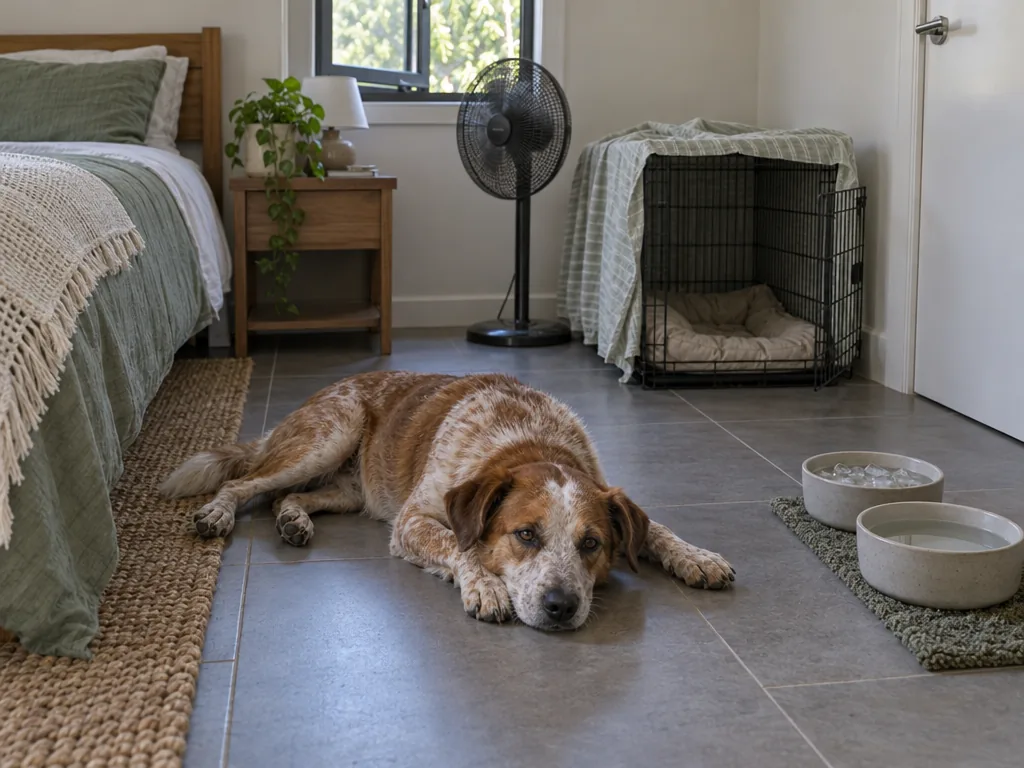
A pet underfoot on a hot moving day is at risk twice over: from the heat, and from an open front door. The NSW Government warns that frightened animals can bite, scratch or run. Secure them early, in a crate if you use one, with a light cloth over the crate to help settle them.
Give them a room, or a friend's place, away from the traffic. Keep pets in a cool, ventilated space with shade and fresh water, with at least two water bowls. Council suggests ice cubes in pets' water. Leave a note on the front door saying which animals are on the property, so nobody opens the wrong door.
Never park a pet while you load. The NSW Government is plain on this: never leave pets alone in a car, even with windows open or in the shade, and never leave a pet on a ute tray in extreme heat.
Some animals struggle more than others. RSPCA NSW names rabbits, birds and short-faced dogs and cats, such as pugs and bulldogs, as especially vulnerable. Its test for walks is this: if the pavement is too hot to hold your hand on for five seconds, it's too hot for a dog's paws. If you use wet towels to cool an animal, RSPCA NSW says to replace them regularly so they don't trap heat.
The signs of heatstroke in animals are rapid panting, lethargy, drooling, weakness, muscle tremors, collapse and confusion. If you see them, contact the nearest vet immediately.
Before the move, check that your pet is microchipped and registered with the NSW Pet Registry, and keep a recent photo on your phone. An escaped animal is easier to bring home with both.
Which belongings to keep out of the heat
Travels with you, kept cool
- Medicines: ask your doctor or pharmacist about heat and fridge storage
- Lithium-ion batteries and e-bike or scooter batteries: cool, dry, away from sunlight and flammables, cooled after use
Check the label or maker's advice
- Candles
- Cosmetics
- Electronics
Stays out of the load
- A battery that is swelling, leaking, overheating or has been wet: kept in a well-ventilated spot at least 3 m from any structure or anything combustible, never in a household or kerbside bin
Source: NSW Government, prepare your household; NSW Fair Trading, lithium-ion batteries
A few things should travel with you, kept cool, rather than sit in a packed load.
Medicines. Ask your doctor or pharmacist whether any of them should be stored in the fridge or change in severe heat, and keep a supply with you rather than in a box. The same NSW page suggests having enough medicine at home through a heatwave. During a move, home means the new address.
Lithium-ion batteries, e-bikes and scooters. NSW Fair Trading says to charge and store these batteries in a cool, dry place away from sunlight and flammables, and to let them cool after use. Don't use one that is swelling, leaking, overheating or has been wet. A damaged battery belongs in a well-ventilated spot at least 3 m from any structure or anything combustible until it can be disposed of safely, never in a household or kerbside bin, so keep it out of the load. For disposal, NSW Fair Trading points to a B-cycle accredited battery collector or the NSW EPA Environment Line on 131 500.
Candles, cosmetics and electronics. Check the label or the maker's advice for storage temperatures, and pack anything with a warning to travel with you.
Cooling the new home before you arrive
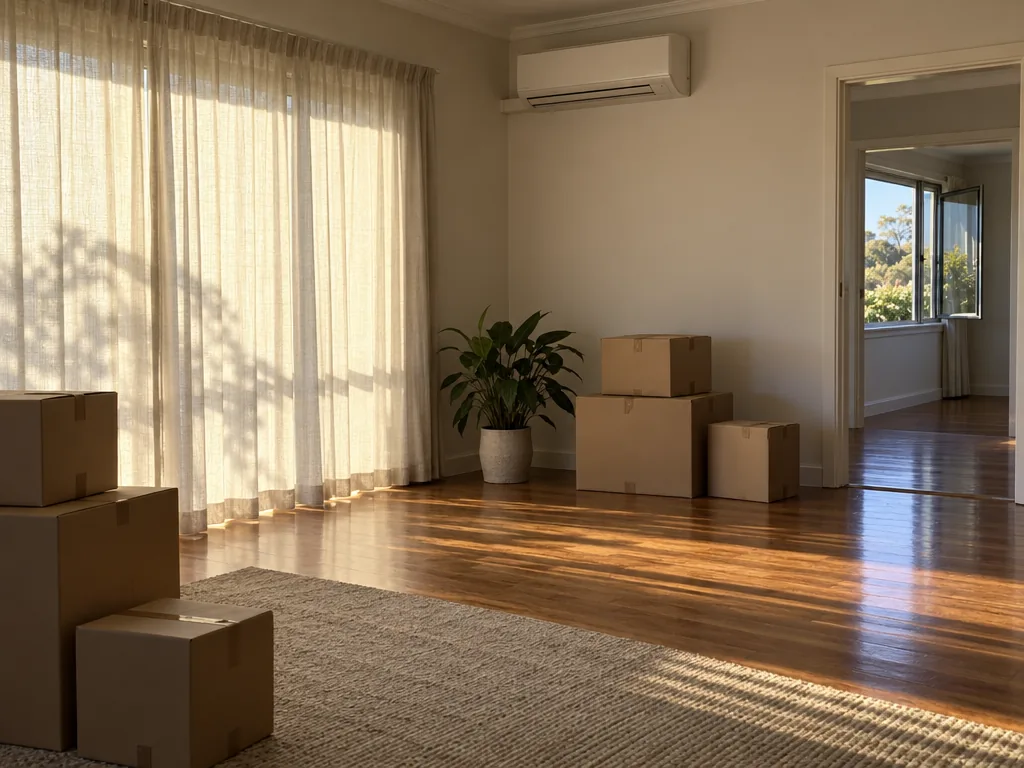
The new place has often been shut up for days. If you can get in early, start cooling it before the first box arrives.
The NSW Government suggests reflective window coverings or pale-lined curtains, especially on west-facing windows, and sealing gaps. Set the air-conditioning to "cool", and check that you can cross-ventilate without compromising security. On moving day, with doors propped open, that matters more than usual.
Stock the new kitchen before you need it. The same page suggests a week of food, pets included, plus enough medicine.
If the new home has no air-conditioning, Council points to libraries, cinemas or shopping centres as places to cool off during the worst of it.
Hot-day figures at a glance
- Heatwave: 3 or more days of unusually hot maximum and minimum temperatures (BoM)
- Warnings: up to 4 days ahead for severe or extreme heatwaves, forecasts up to 7 days, issued at 3 pm local time (BoM)
- Water while working in heat: 200 ml of cool water every 15 to 20 minutes (SafeWork NSW)
- Rest in hot, humid, physical work: about every hour, up to 30 minutes in every hour (SafeWork NSW)
- Heatstroke: body temperature above 40 °C, call 000 (heat exhaustion 38 to 39 °C) (CDC)
- Dog paws: pavement too hot for your hand for 5 seconds is too hot (RSPCA NSW)
- Damaged lithium-ion battery: at least 3 m from any structure or anything combustible (NSW Fair Trading)
These are the numbers worth keeping on your phone for a summer move:
- A heatwave is 3 or more days of unusually hot maximum and minimum temperatures.
- Severe or extreme heatwave warnings come up to 4 days ahead, with forecasts up to 7 days ahead, issued at 3 pm local time.
- When working in heat, drink 200 ml of cool water every 15 to 20 minutes.
- In hot, humid, physical work, rest about every hour, up to 30 minutes in every hour as conditions worsen.
- A body temperature above 40 °C with heatstroke signs means call 000.
- If you can't hold your hand on the pavement for five seconds, it is too hot for a dog's paws.
- Keep a damaged lithium-ion battery at least 3 m from any structure or anything combustible.
Booking a summer move with Palm Beach Removals
If your move falls between now and the end of March, plan around the heat now, while you still have choices about the date and the start time.
Tell us your moving date, both addresses and what the access looks like at each end. A long or steep carry is harder work on a hot day, and our guide to grading hillside access will help you describe yours. Ask us how a very hot day would be handled for your move.
You can start through our quote page.
Sources
- https://www.bom.gov.au/news-and-media/heatwaves-what-you-need-to-know
- https://www.bom.gov.au/resources/learn-and-explore/heatwave-knowledge-centre/heatwave-services
- https://www.nsw.gov.au/emergency/heatwaves/understand-your-risk
- https://www.nsw.gov.au/about-nsw/school-holidays
- https://www.cdc.gov.au/advice/coping-heatwaves
- https://www.safework.nsw.gov.au/resource-library/heat-and-environment/working-in-extreme-heat-the-facts
- https://www.nsw.gov.au/emergency/heatwaves/prepare-your-household
- https://www.nsw.gov.au/emergency/get-ready/get-ready-animals
- https://www.rspcansw.org.au/animal-care-information/keeping-pets-safe-in-the-heat-essential-tips-for-pet-owners/
- https://www.northernbeaches.nsw.gov.au/council/news/hot-weather-incoming-how-to-beat-heat
- https://www.nsw.gov.au/housing-and-construction/safety-home/electrical-safety/lithium-ion-batteries-and-e-micromobility-devices